How long does it take to build a habit? What to do after a missed day
You have probably heard that it takes 21 days to build a habit. That number is a myth with no solid study behind it. The research that does exist is more interesting, and more forgiving, than the slogan.
What the study actually found
Phillippa Lally and colleagues at University College London asked 96 volunteers to pick a simple daily behaviour, like drinking a glass of water after breakfast or going for a run before dinner, and to report each day how automatic it felt. The results were published in 2010 in the *European Journal of Social Psychology*.
Three findings matter for you:
- On average, it took 66 days for the behaviour to feel automatic.
- The range was huge, from 18 days to 254 days, depending on the person and the behaviour.
- Missing a single day did not meaningfully derail the process. What mattered was getting back to it.
It was a small study of volunteers, so treat the numbers as a rough guide, not a deadline. But the message holds up well in practice: habits take weeks to months, and perfection is not required.
Why this matters if your attention is unreliable
If you struggle with focus or executive function, you may have a long history of starting routines with energy and dropping them quietly after a bad week. The "21 days" myth makes that worse: on day 22 the habit is supposed to be done, so a struggle feels like failure.
A better frame: you are not testing your willpower, you are running a long experiment where missed days are data. (A note on scope: a planner is an organisation tool, not a treatment. If attention problems seriously affect your life, a healthcare professional can help.)
Step 1: pick one habit and make it tiny
Choose a single behaviour. Make it so small that it feels almost silly: put on your running shoes, write one sentence, open the budget file. You can always do more, but the minimum should take under two minutes.
Step 2: attach it to something that already happens
Habits stick more easily when they follow an existing cue. Use a when… then… rule:
- When I pour my morning coffee, then I write my three priorities.
- When I sit down at my desk, then I open my to-do page.
This idea, called an implementation intention, is covered in more depth in our guide on how to use a planner with ADHD. The point here: choose a cue that happens every day without effort, not a time you have to remember.
Step 3: track with a mark, not a score
Use a simple grid with one box per day. Colour or tick the box when you did the tiny version. Do not rate yourself, do not track streaks as a measure of worth, and do not add a second habit until the first one feels easy.
A visual record does one quiet job: it shows the pattern. After three weeks, you can see that you do the habit on weekdays but not on Sundays, and you can change the plan instead of blaming yourself.
Step 4: have a missed-day rule ready
Decide now, while you are calm, what happens after a miss. A good default is never miss twice:
- One missed day is normal. Do not make up for it with a double workload.
- The day after a miss, do the smallest possible version. Thirty seconds counts.
- If you miss several days, restart at the tiny version and keep the grid going. Do not wipe the page and begin again.
The study supports this approach: a single lapse was not a big problem, so the goal is to shorten the gap, not to avoid every gap.
Step 5: review once a week
On the same day each week, spend ten minutes asking three questions:
- When did I do it easily?
- When did I skip, and what was going on?
- What one thing will I change next week: the cue, the size, or the place?
Change one variable at a time. If you change everything, you will not know what helped.
What to expect
Do not expect a switch to flip on day 66. For some habits it may happen sooner; for others later. Notice instead the small signs: you start without arguing with yourself, you feel slightly odd when you skip it, or the cue triggers the action before you think.
Putting it in a planner
The Focus ADHD Planner has a daily page with three priorities, estimated vs actual time and a trigger line, plus a 66-day challenge and a "hard day" page for the days that go sideways. It works on paper or on a tablet. Start with one tiny habit and give it a fair run of a couple of months.
The best habit system is the one you can come back to after a bad week. Build that first.
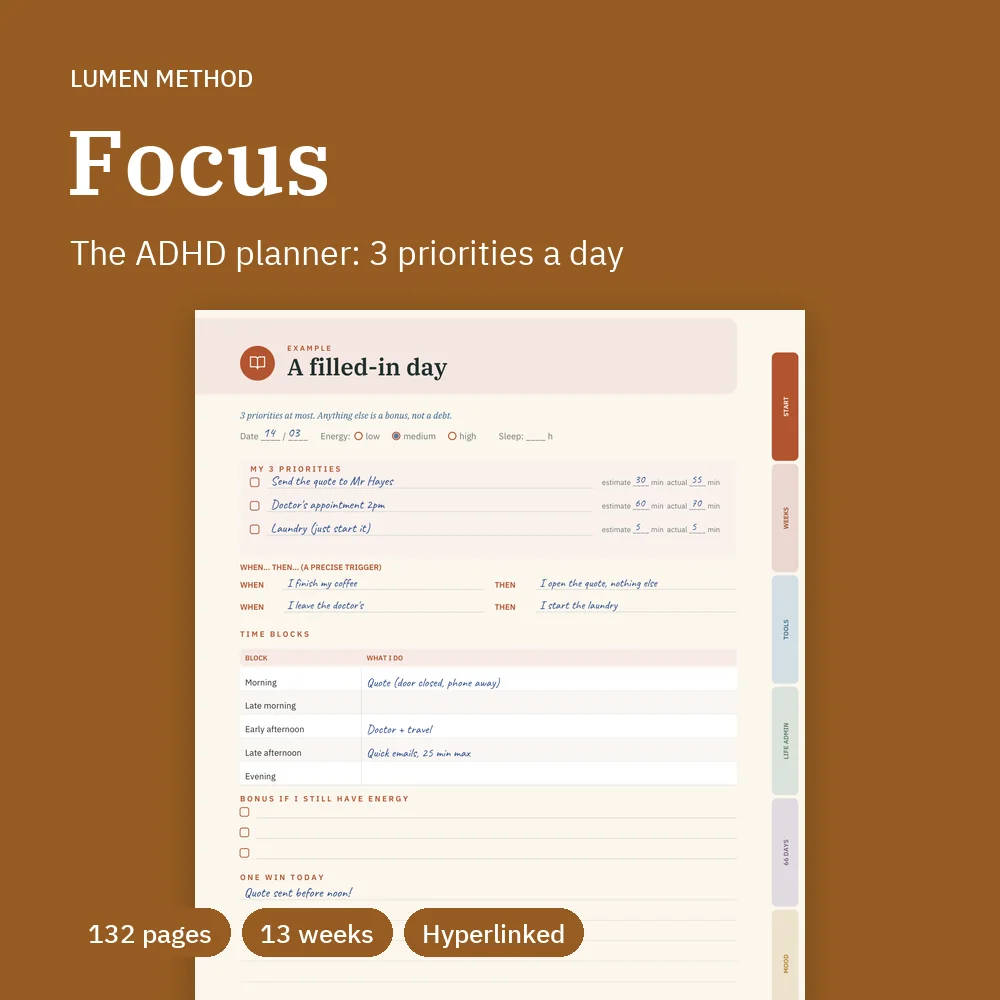
Three priorities a day, precise triggers, and the right to miss a day. 13 linked weeks.
See it — $17