How to set up sinking funds: a simple system for irregular expenses
Most budgets don't fail because of the big monthly bills. They fail because of the ones that show up twice a year: car repairs, insurance premiums, gifts, a vet visit. A sinking fund is the simple fix, and you can set one up in about twenty minutes.
What a sinking fund is
A sinking fund is money you set aside in small, regular amounts for a known future expense. Instead of facing a 600 bill in one go, you put aside a fixed amount each month so the money is already there when the bill arrives. It is different from an emergency fund, which covers things you can't predict. Sinking funds are for things you can predict but forget to plan for.
Why separating money into named pots works
Economist Richard Thaler described this habit in "Mental Accounting Matters" (*Journal of Behavioral Decision Making*, 1999). He argued that people naturally sort money into mental categories and that those categories shape our spending choices, even though money is technically interchangeable. Rather than fighting that tendency, a sinking fund uses it: when a pot has a name and a purpose, it is harder to spend it on something else by accident.
That is the idea, not a guarantee. Whether it works for you depends on whether you actually keep the pots separate and top them up.
Step 1: List your irregular expenses
Go through your last twelve months of bank statements and pick out everything that wasn't a monthly bill. Typical candidates:
- Annual insurance or subscription renewals
- Car maintenance and repairs
- Holidays and travel
- Gifts and celebrations
- Medical, dental and optical costs
- Home repairs or replacing appliances
- Pet costs
If you are unsure of an amount, use last year's actual spending as a starting point and adjust later.
Step 2: Estimate each cost and divide
For each item, estimate the yearly total and divide by twelve. A few examples with made-up numbers:
- Car insurance of 480 a year becomes 40 a month
- Gifts of 360 a year becomes 30 a month
- Holiday of 1,200 a year becomes 100 a month
Add everything up. That total is your monthly sinking fund contribution. If it feels too high, don't give up: start with the two or three items that hurt the most and add the rest later.
Step 3: Decide where the money lives
You have three simple options:
- One savings account, tracked in a table. Easiest to run. You keep a list showing how much belongs to each category.
- Several sub-accounts or pots, if your bank offers them for free. Clearer, but more to manage.
- Cash envelopes for small categories, if you prefer something physical.
Pick the option you will actually maintain. A simple system you follow beats a clever one you abandon.
Step 4: Automate the transfer
Set a standing order for the day after payday. The goal is that you never have to decide to save: it just happens. Then update your tracking table once a month, which takes about five minutes.
Step 5: Spend from the fund without guilt
When the bill arrives, pay it from the fund and write down the amount. That is the whole point. If a category runs short, borrow from another one on purpose, note it, and refill it next month.
Common mistakes
- Too many categories. Start with five or six, not twenty.
- Forgetting to review. Once a year, compare what you set aside with what you really spent and adjust.
- Treating the fund as spare cash. If it has a purpose, keep it for that purpose.
- Setting amounts too tight. Add a small margin, because prices tend to creep up.
A quick monthly routine
On the first of the month, check three things: did the transfer go through, is any category below where it should be, and is a big expense coming in the next two months? That's it.
This article is general information, not financial advice, and amounts and account types vary by country and bank.
If you also have debts to deal with, our guide to using a planner when your attention drifts shows how to make a routine like this stick. For a ready-made layout with category tables and monthly checks, see the Clear Budget planner.
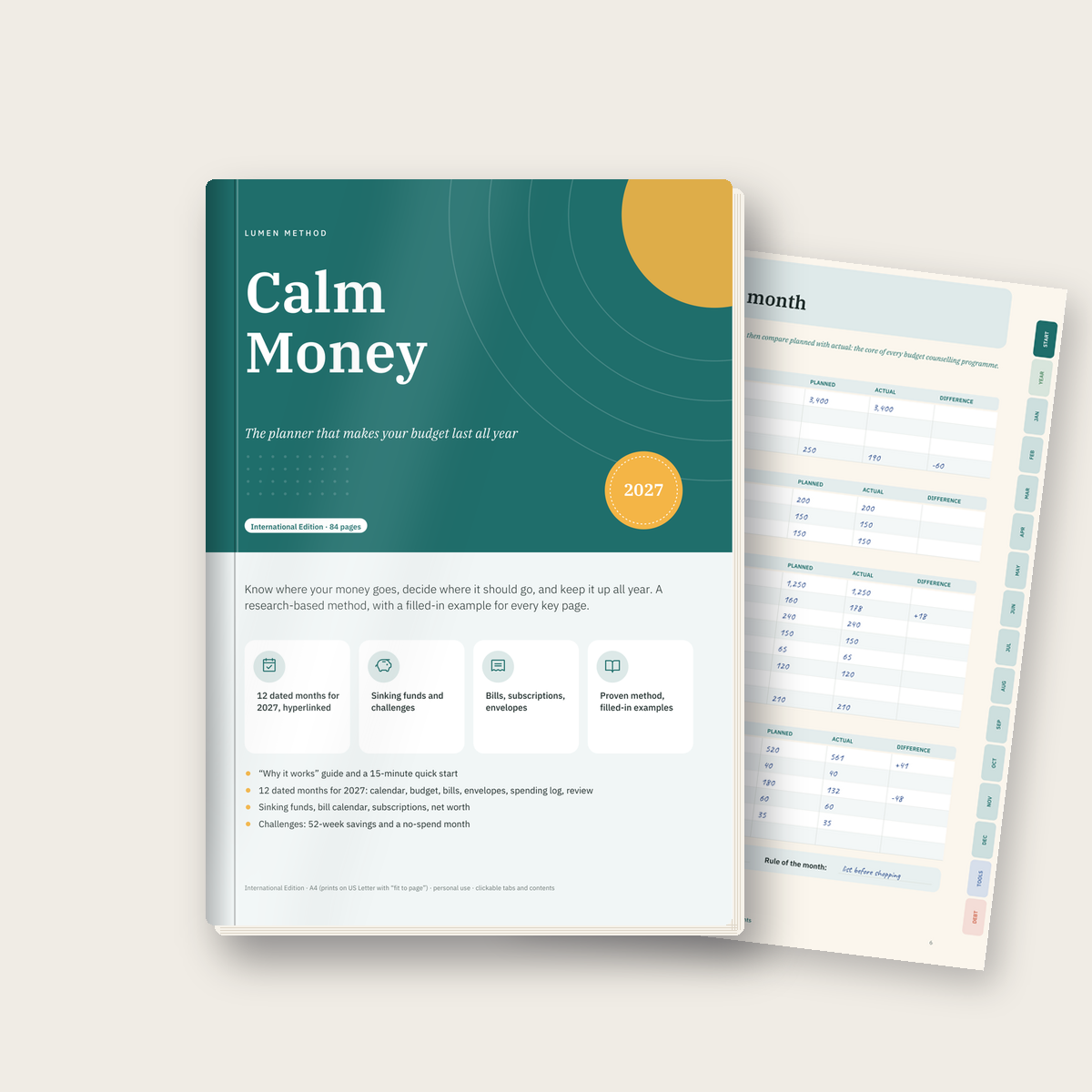
A dated 2027 budget planner built on behavioural research, not willpower. Works in any currency.
See it · $17